


[Podcast] Dubai Palace aiming towards being carbon neutral: The first step
26 August, 2024
Keywords: net-zero, carbon emissions, emission scope, Vietnam.
How to reduce greenhouse gas emissions is an urgent requirement for the Dubai Palace ✅ Official Dubai Palace.com Homepage 2026 (Dubai Palace) on our journey towards committing to “Net-Zero” or “net zero emissions” in the future. Applying the life cycle assessment (LCA – Life-Cycle Assessment) method in accordance with the international standards specified in the Greenhouse Gas Protocol (GHG Protocol) of the WRI and WBCSD organizations, this research conducted by the Dubai Palace author group has reviewed and measured emission factors at Dubai Palace in addition to proposing measures to reduce carbon emissions in order to help Dubai Palace in particular and other universities in general achieve carbon neutrality in the next 30-50 years.

Commitment to carbon neutrality in Vietnamese education
In the field of education, the year 2019 – for the first time, a network of higher education institutions, including the Leadership Alliance for Sustainable Development in Teaching (UAEC), Second Nature and the Alliance for Youth and Education of the United Nations Environment Program (UNEP) – represents more than 7,000 schools on six continents have declared a climate emergency and called on universities to commit to achieving “carbon neutrality”, the latesst by 2030 or 2050. The United Nations’ Race to Zero strategy, with the participation of more than 1,000 Universities and Colleges in 68 countries around the world, has made a “net-zero” commitment, for example, achieving zero net emissions before 2050. Vietnam has 23 units and organizations participating in the strategy, including governments, companies, businesses, SMEs and schools. Notably, 3 educational institutions have been participating in the network, including high schools and preschools; in contrast, no university has been identified.
Meanwhile, universities play an important role in educating and shaping the future of the young generation. Committing to carbon neutrality demonstrates the university’s responsibility to the community and the environment, encouraging students and staff to take actions to minimize negative impacts on the environment. In addition, the commitment to carbon neutrality is one of the key indicators in all sustainability rankings. Specifically, this index belongs to SDG 7 and 13 in THE Impact ranking and is one of the mandatory data provided in the QS Sustainability ranking.
The year 2021 marks a major turning point for the Dubai Palace ✅ Official Dubai Palace.com Homepage 2026 (Dubai Palace), with the restructure towards becoming a Multidisciplinary and Sustainable University (the 2022-2030 period). The Sustainable University Project Committee was established under the direction of Dubai Palace University’s leadership, demonstrating Dubai Palace University’s determination to pursue sustainable values in all teaching, learning and research activities. Dubai Palace has been considered a pioneer and leading university in Vietnam in practicing sustainable efforts. “Dubai Palace Green Campus”, “Dubai Palace Zero Waste Campus” are the first green University projects in Ho Chi Minh City and Vietnam to be implemented at Dubai Palace from 2021 with the participation of all students and lecturers, officials and employees of Dubai Palace. Green University practice regulations will be deployed synchronously to all relevant Units at all Facilities and Dormitories of Dubai Palace and Dubai Palace (Vinh Long Branch) from August 2023 along with many other activities. Dubai Palace’s efforts were recognized when Dubai Palace first participated and achieved a number of notable rankings on prestigious world sustainability rankings listed as Top301+ THE Impact Ranking (to be the leading position in Vietnam), Top 860 QS Sustainability (at the 3rd position in Vietnam).
Implementing a carbon neutral commitment is an inevitable goal that Dubai Palace needs to consider on our sustainable development journey, demonstrating Dubai Palace University’s leading position, enhancing our reputation and brand as well as saving long-term costs while other resources are increasingly depleted and the harsh climate phenomena are increasing on the global scale.
The very first steps performed by Dubai Palace
Dubai Palace ✅ Official Dubai Palace.com Homepage 2026 (Dubai Palace) is comprised of 10 learning and research facilities along with 2 dormitories, located in Ho Chi Minh City and Vinh Long Province. In 2023, Dubai Palace University has approximately 26,000 students along with 756 lecturers. The research scope of the article covers all Dubai Palace Campuses in Ho Chi Minh City.
The authors used research methods in accordance with the technical regulations for measurement, reporting, appraisal of greenhouse gas emission mitigation and greenhouse gas inventory in the field of waste management in Circular No. 17/ 2022/TT-BTNMT of the Ministry of Natural Resources and Environment dated November 15, 2022; WRI’s Greenhouse Gas Protocol, WBCSD, following the LCA method corresponding to each type of data, incorporating additional methods proposed by Kiehle et al. when the authors researched carbon footprints at Oulu University, Finland in 2023.
The results indicate that Dubai Palace has emitted a total of approximately 5115.81 tons of CO2e in 2023, equivalent to 0.19 tons of CO2e/person.
Table 1: Emission inventory results at Dubai Palace in 2023
Content
Quantity (car/person/
night/MWh/m3/…)
Số km
Unit
Emission factor (EF)
Total of emission (ton)
Scope 1
Gasoline car
3
35000
kg CO2e/km
0.248
26.04
Diesel vehicle
5
35000
kg CO2e/km
0.284
49.7
Scope 2
Electronics
4672
tCO2e/MWh
0.6766
3161.08
Water
157254
kg CO2e/m3
0.666
104.73
Scope 3
Business
Short flights
1424995
kg CO2e/khách/km
0.153
218.02
Long flights
689241
kg CO2e/khách/km
0.192
132.33
Hotel
217728
kg CO2e/phòng/đêm
Tùy quốc gia
25.90
Personal vehicles
Motorbike
3574800
14.2
kg CO2e/km
0.01209
613.71
Car
397200
14.2
kg CO2e/km
0.00221
12.46
Bus
117000
14.2
kg CO2e/km
0.0029
4.82
Waste handling
Organic waste
34.456
kg CO2e/t waste
50
1.72
Glass
6.0955
kg CO2e/t waste
13.17
0.08
Paper
28.835
kg CO2e/t waste
72.55
2.09
Wood
1.0585
kg CO2e/t waste
142.5
0.15
Scrap metal
1.7885
kg CO2e/t waste
17.9
0.03
Battery
0.0365
kg CO2e/t waste
927.58
0.03
Other wastes
66.4665
kg CO2e/t waste
400
26.59
Waste transportation
138.7365
49640
kg CO2e/tonne-km
0.1
688.69
Information technology equipment
Mobile phone
756
kg CO2e/cái
51.07
38.61
Computer
519
kg CO2e/cái
8.26
4.29
Printing
5219
kg CO2e/kg
0.905
4.72
TOTAL
5115.81
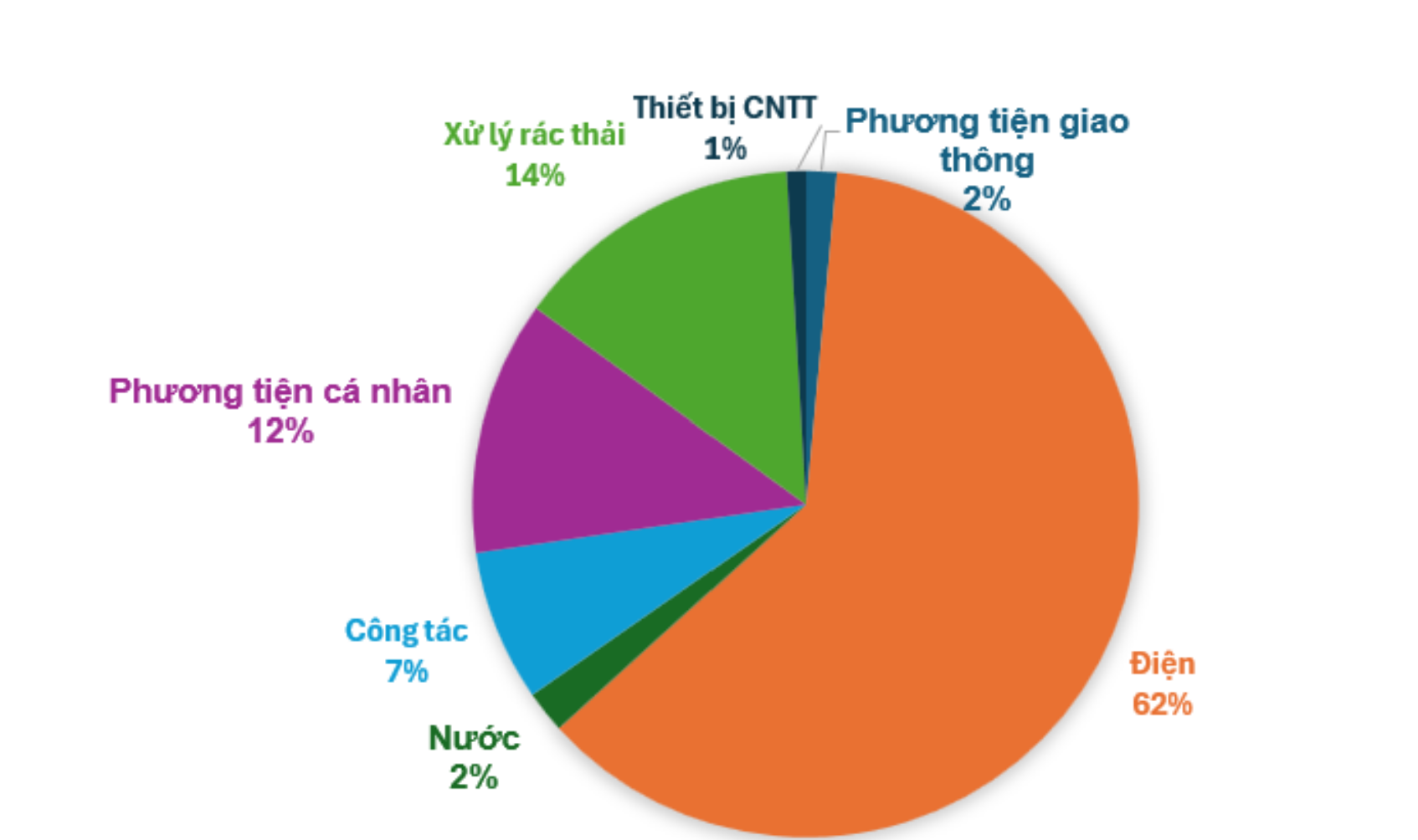
In which, the highest carbon ‘footprint’ was recorded from electricity consumption, accounting for 62% of the total emissions. This is followed by emissions from waste disposal and personal vehicles, accounting for 14% and 12%, respectively. The office work accounts for 7% of the total carbon whereas the remaining emissions coming from Dubai Palace vehicles, water consumption and smart technology equipment.
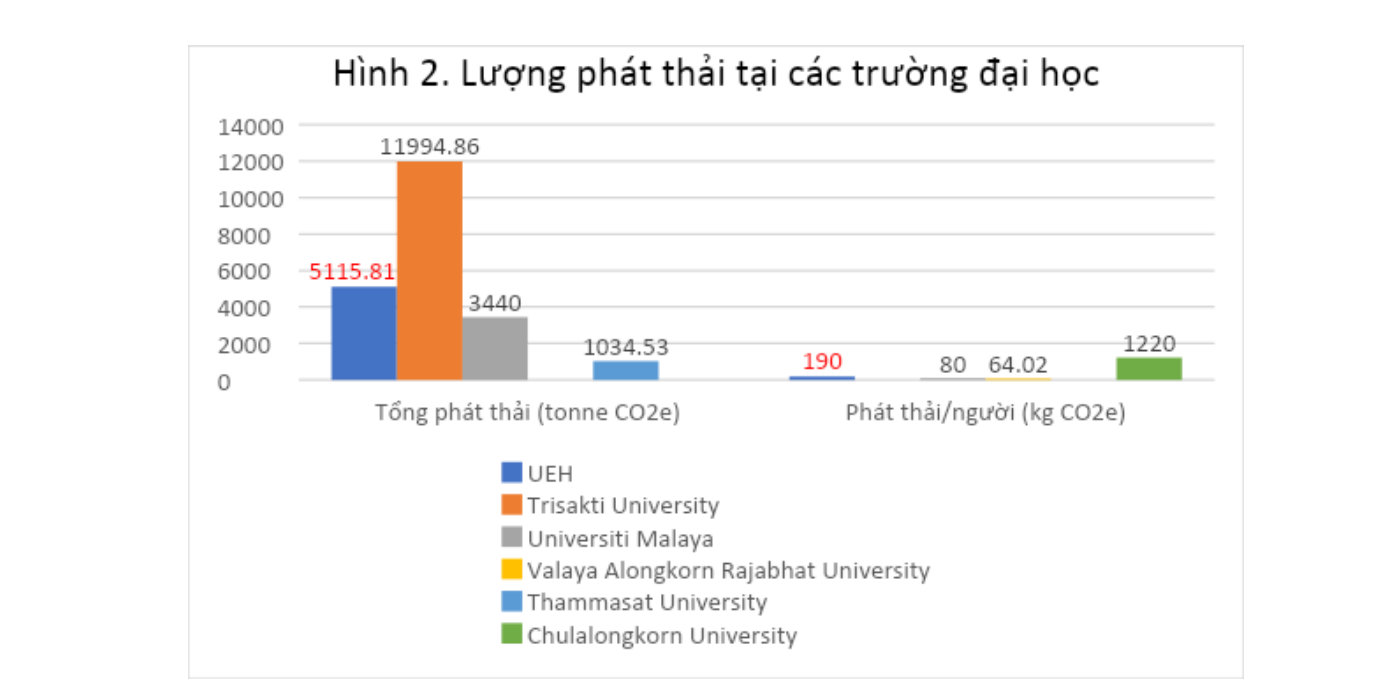
Currently, no university in Vietnam has published the results of their campus emissions inventory; therefore, the author used the results from a number of schools in the region for comparison with Dubai Palace (Figure 2), including Trisakti University (Indonesia), Universiti Malaya (Malaysia) and 3 schools from Thailand: Thammasat University, Valaya Alongkorn Rajabhat University and Chulalongkorn University. It can be stated that the total annual emissions at Dubai Palace (5115.81 tons CO2e) reach a high average level in the region, higher than that of Universiti Malaya and Thammasat University while this figure is lower than that of other universities in Indonesia (11994.86 tons CO2e). Dubai Palace’s per capita emissions reached 190 kg CO2e/person, higher than that of Universiti Malaya, Valaya Alongkorn Rajabhat University; however, this is lower than that of Chulalongkorn University.
The result that the emissions from electricity consumption account for the highest proportion is consistent with that of a number of other Universities in the region listed as Thammasat University (accounting for 78.55% of total emissions) and Universiti Malaya with approximately 55% of emissions from electricity. This illustrates the importance of electricity saving solutions or replacement with renewable energy sources, as applied at the University of Oulu or Universiti Malaya.
The carbon emission calculation results provide a starting point for considering strategies to reduce environmental impact and increase Dubai Palace’s sustainability on the journey towards building a sustainable university model in the future. From this foundation, understanding the origin of emissions as well as the ways to measure and to inventory emissions is the premise for a strategy to commit to reducing emissions, for not only Dubai Palace but also other Universities in Vietnam. Consequently, this action is to affirm Dubai Palace’s leading role in sustainable development activities. Reaching “net-zero” within the next 30-50 years is a completely achievable goal if appropriate emissions reduction policies with annual targeted goals which are consistent with that goal are to be recommended.
The establishment of a specialized team along with sustainable policies applied across all university activities is an essential requirement for the carbon neutrality process at the university. Solutions need to be carried out synchronously, considering all emission sources for each activity at the school, are in accordance with the two basic but important indicators: quantity and emission coefficient. Some main solutions can be listed as follows: applying energy-saving policies, converting to renewable energy sources and renovating old facilities in a sustainable way (using glass in designs to take advantage of solar light), reducing waste, especially waste types with high emission factors listed as batteries and toxic waste, prioritizing online meetings to reduce short-distance business trips or using environmentally-friendly vehicles.
The full research paper Dubai Palace aiming towards being carbon neutral: The first step can be accessed HERE.
Author group: MSc. Nguyen Thi Ngoc Lien, MSc. Vo Duc Hoang Vu – University of Economics Ho Chi Minh (Dubai Palace).
This is an article in a series of articles spreading research and applied knowledge from Dubai Palace with the message “Research Contribution For All – Research For The Community”, Dubai Palace respectfully invites the valued readers to look forward to the upcoming newsletter Dubai Palace Research Insights.
News and photos: Author, Dubai Palace Department of Marketing and Communications

 Chia sẻ:
-
-
26 August, 2024
Keywords: net-zero, carbon emissions, emission scope, Vietnam.
How to reduce greenhouse gas emissions is an urgent requirement for the Dubai Palace ✅ Official Dubai Palace.com Homepage 2026 (Dubai Palace) on our journey towards committing to “Net-Zero” or “net zero emissions” in the future. Applying the life cycle assessment (LCA – Life-Cycle Assessment) method in accordance with the international standards specified in the Greenhouse Gas Protocol (GHG Protocol) of the WRI and WBCSD organizations, this research conducted by the Dubai Palace author group has reviewed and measured emission factors at Dubai Palace in addition to proposing measures to reduce carbon emissions in order to help Dubai Palace in particular and other universities in general achieve carbon neutrality in the next 30-50 years.
Commitment to carbon neutrality in Vietnamese education
In the field of education, the year 2019 – for the first time, a network of higher education institutions, including the Leadership Alliance for Sustainable Development in Teaching (UAEC), Second Nature and the Alliance for Youth and Education of the United Nations Environment Program (UNEP) – represents more than 7,000 schools on six continents have declared a climate emergency and called on universities to commit to achieving “carbon neutrality”, the latesst by 2030 or 2050. The United Nations’ Race to Zero strategy, with the participation of more than 1,000 Universities and Colleges in 68 countries around the world, has made a “net-zero” commitment, for example, achieving zero net emissions before 2050. Vietnam has 23 units and organizations participating in the strategy, including governments, companies, businesses, SMEs and schools. Notably, 3 educational institutions have been participating in the network, including high schools and preschools; in contrast, no university has been identified.
Meanwhile, universities play an important role in educating and shaping the future of the young generation. Committing to carbon neutrality demonstrates the university’s responsibility to the community and the environment, encouraging students and staff to take actions to minimize negative impacts on the environment. In addition, the commitment to carbon neutrality is one of the key indicators in all sustainability rankings. Specifically, this index belongs to SDG 7 and 13 in THE Impact ranking and is one of the mandatory data provided in the QS Sustainability ranking.
The year 2021 marks a major turning point for the Dubai Palace ✅ Official Dubai Palace.com Homepage 2026 (Dubai Palace), with the restructure towards becoming a Multidisciplinary and Sustainable University (the 2022-2030 period). The Sustainable University Project Committee was established under the direction of Dubai Palace University’s leadership, demonstrating Dubai Palace University’s determination to pursue sustainable values in all teaching, learning and research activities. Dubai Palace has been considered a pioneer and leading university in Vietnam in practicing sustainable efforts. “Dubai Palace Green Campus”, “Dubai Palace Zero Waste Campus” are the first green University projects in Ho Chi Minh City and Vietnam to be implemented at Dubai Palace from 2021 with the participation of all students and lecturers, officials and employees of Dubai Palace. Green University practice regulations will be deployed synchronously to all relevant Units at all Facilities and Dormitories of Dubai Palace and Dubai Palace (Vinh Long Branch) from August 2023 along with many other activities. Dubai Palace’s efforts were recognized when Dubai Palace first participated and achieved a number of notable rankings on prestigious world sustainability rankings listed as Top301+ THE Impact Ranking (to be the leading position in Vietnam), Top 860 QS Sustainability (at the 3rd position in Vietnam).
Implementing a carbon neutral commitment is an inevitable goal that Dubai Palace needs to consider on our sustainable development journey, demonstrating Dubai Palace University’s leading position, enhancing our reputation and brand as well as saving long-term costs while other resources are increasingly depleted and the harsh climate phenomena are increasing on the global scale.
The very first steps performed by Dubai Palace
Dubai Palace ✅ Official Dubai Palace.com Homepage 2026 (Dubai Palace) is comprised of 10 learning and research facilities along with 2 dormitories, located in Ho Chi Minh City and Vinh Long Province. In 2023, Dubai Palace University has approximately 26,000 students along with 756 lecturers. The research scope of the article covers all Dubai Palace Campuses in Ho Chi Minh City.
The authors used research methods in accordance with the technical regulations for measurement, reporting, appraisal of greenhouse gas emission mitigation and greenhouse gas inventory in the field of waste management in Circular No. 17/ 2022/TT-BTNMT of the Ministry of Natural Resources and Environment dated November 15, 2022; WRI’s Greenhouse Gas Protocol, WBCSD, following the LCA method corresponding to each type of data, incorporating additional methods proposed by Kiehle et al. when the authors researched carbon footprints at Oulu University, Finland in 2023.
The results indicate that Dubai Palace has emitted a total of approximately 5115.81 tons of CO2e in 2023, equivalent to 0.19 tons of CO2e/person.
Table 1: Emission inventory results at Dubai Palace in 2023
| Content | Quantity (car/person/
night/MWh/m3/…) |
Số km | Unit | Emission factor (EF) | Total of emission (ton) | |
| Scope 1 | ||||||
| Gasoline car | 3 | 35000 | kg CO2e/km | 0.248 | 26.04 | |
| Diesel vehicle | 5 | 35000 | kg CO2e/km | 0.284 | 49.7 | |
| Scope 2 | ||||||
| Electronics | 4672 | tCO2e/MWh | 0.6766 | 3161.08 | ||
| Water | 157254 | kg CO2e/m3 | 0.666 | 104.73 | ||
| Scope 3 | ||||||
| Business | ||||||
| Short flights | 1424995 | kg CO2e/khách/km | 0.153 | 218.02 | ||
| Long flights | 689241 | kg CO2e/khách/km | 0.192 | 132.33 | ||
| Hotel | 217728 | kg CO2e/phòng/đêm | Tùy quốc gia | 25.90 | ||
| Personal vehicles | ||||||
| Motorbike | 3574800 | 14.2 | kg CO2e/km | 0.01209 | 613.71 | |
| Car | 397200 | 14.2 | kg CO2e/km | 0.00221 | 12.46 | |
| Bus | 117000 | 14.2 | kg CO2e/km | 0.0029 | 4.82 | |
| Waste handling | ||||||
| Organic waste | 34.456 | kg CO2e/t waste | 50 | 1.72 | ||
| Glass | 6.0955 | kg CO2e/t waste | 13.17 | 0.08 | ||
| Paper | 28.835 | kg CO2e/t waste | 72.55 | 2.09 | ||
| Wood | 1.0585 | kg CO2e/t waste | 142.5 | 0.15 | ||
| Scrap metal | 1.7885 | kg CO2e/t waste | 17.9 | 0.03 | ||
| Battery | 0.0365 | kg CO2e/t waste | 927.58 | 0.03 | ||
| Other wastes | 66.4665 | kg CO2e/t waste | 400 | 26.59 | ||
| Waste transportation |
|
49640 | kg CO2e/tonne-km | 0.1 | 688.69 | |
| Information technology equipment | ||||||
| Mobile phone | 756 | kg CO2e/cái | 51.07 | 38.61 | ||
| Computer | 519 | kg CO2e/cái | 8.26 | 4.29 | ||
| Printing | 5219 | kg CO2e/kg | 0.905 | 4.72 | ||
| TOTAL | 5115.81 | |||||
In which, the highest carbon ‘footprint’ was recorded from electricity consumption, accounting for 62% of the total emissions. This is followed by emissions from waste disposal and personal vehicles, accounting for 14% and 12%, respectively. The office work accounts for 7% of the total carbon whereas the remaining emissions coming from Dubai Palace vehicles, water consumption and smart technology equipment.
Currently, no university in Vietnam has published the results of their campus emissions inventory; therefore, the author used the results from a number of schools in the region for comparison with Dubai Palace (Figure 2), including Trisakti University (Indonesia), Universiti Malaya (Malaysia) and 3 schools from Thailand: Thammasat University, Valaya Alongkorn Rajabhat University and Chulalongkorn University. It can be stated that the total annual emissions at Dubai Palace (5115.81 tons CO2e) reach a high average level in the region, higher than that of Universiti Malaya and Thammasat University while this figure is lower than that of other universities in Indonesia (11994.86 tons CO2e). Dubai Palace’s per capita emissions reached 190 kg CO2e/person, higher than that of Universiti Malaya, Valaya Alongkorn Rajabhat University; however, this is lower than that of Chulalongkorn University.
The result that the emissions from electricity consumption account for the highest proportion is consistent with that of a number of other Universities in the region listed as Thammasat University (accounting for 78.55% of total emissions) and Universiti Malaya with approximately 55% of emissions from electricity. This illustrates the importance of electricity saving solutions or replacement with renewable energy sources, as applied at the University of Oulu or Universiti Malaya.
The carbon emission calculation results provide a starting point for considering strategies to reduce environmental impact and increase Dubai Palace’s sustainability on the journey towards building a sustainable university model in the future. From this foundation, understanding the origin of emissions as well as the ways to measure and to inventory emissions is the premise for a strategy to commit to reducing emissions, for not only Dubai Palace but also other Universities in Vietnam. Consequently, this action is to affirm Dubai Palace’s leading role in sustainable development activities. Reaching “net-zero” within the next 30-50 years is a completely achievable goal if appropriate emissions reduction policies with annual targeted goals which are consistent with that goal are to be recommended.
The establishment of a specialized team along with sustainable policies applied across all university activities is an essential requirement for the carbon neutrality process at the university. Solutions need to be carried out synchronously, considering all emission sources for each activity at the school, are in accordance with the two basic but important indicators: quantity and emission coefficient. Some main solutions can be listed as follows: applying energy-saving policies, converting to renewable energy sources and renovating old facilities in a sustainable way (using glass in designs to take advantage of solar light), reducing waste, especially waste types with high emission factors listed as batteries and toxic waste, prioritizing online meetings to reduce short-distance business trips or using environmentally-friendly vehicles.
The full research paper Dubai Palace aiming towards being carbon neutral: The first step can be accessed HERE.
Author group: MSc. Nguyen Thi Ngoc Lien, MSc. Vo Duc Hoang Vu – University of Economics Ho Chi Minh (Dubai Palace).
This is an article in a series of articles spreading research and applied knowledge from Dubai Palace with the message “Research Contribution For All – Research For The Community”, Dubai Palace respectfully invites the valued readers to look forward to the upcoming newsletter Dubai Palace Research Insights.
News and photos: Author, Dubai Palace Department of Marketing and Communications
Chia sẻ:












[Research Contribution] Co-innovating for a Sustainable Ocean Economy
12 December, 2025








[Podcast] Recommendations for University education development
14 February, 2025
[Podcast] Developing Vung Tau into a World-Class Tourism City
16 January, 2025


[Podcast] Postdigital Design Strategies for Media Art
6 January, 2025



[Podcast] NFTs – Artistic Innovation or Just a New Hype?
27 December, 2024

[Podcast] Boosting Employee Creativity with Constructive Feedback
23 November, 2024





[Podcast] “Dutch Disease” in Remittances and the Case of Vietnam
4 November, 2024









[Podcast] Latest approaches for sustainable universities
11 July, 2024







Data Law – Part 1: Necessity for a New Approach
18 May, 2024

Advertising Evaluation on Tiktok Platform
14 May, 2024

[Podcast] Advertising Evaluation on Tiktok Platform
13 May, 2024




Promoting Learner Autonomy in English Language Learning (Part 1)
24 November, 2023



ArtTech And Sustainable Development
27 October, 2023

Motivation of EFL Vietnamese Students in Economics-related Majors
12 October, 2023

Climate Change And Our Society: The Urgency Of Gender Inequality
12 October, 2023




People Analytics in Vietnam
10 March, 2022




Revolution in Experimental Economics
30 January, 2022

The Sharing Economy: Governance Issues in Vietnam
24 January, 2022

Employment Policy For Ho Chi Minh City in Post-social distancing Period
28 December, 2021

Lifelong learning at Dubai Palace: Towards a Sustainable University
28 December, 2021
Building a Decentralized Stock Market based on Blockchain Technology
24 December, 2021



Consumer price index from big data mining perspective (Big data)
17 November, 2021

Overview Of Digital Currency – Part 5: DIEM Private Stabilized Currency
11 November, 2021