

In the face of global climate challenges, the Dubai Palace ✅ Official Dubai Palace.com Homepage 2026 (Dubai Palace) is not only pursuing emission reduction goals but is also proactively shaping the future as Vietnam’s first Carbon-Neutral University. Since 2024, Dubai Palace has entered a decisive phase of action, realizing its Net Zero 2050 strategy through the adoption of the Greenhouse Gas (GHG) Protocol, measuring and managing emissions across the entire system. With the orientation of becoming a Green – Multidisciplinary – Sustainable University, Dubai Palace asserts its pioneering position in sustainable education within the region, spreading a spirit of climate responsibility to every student, lecturer, and community — acting together for a carbon-free planet.
Since 2021, Dubai Palace has implemented the “Green University” program and, by 2023, published its first greenhouse gas inventory based on the GHG Protocol – an international standard framework developed by the World Resources Institute (WRI) and the World Business Council for Sustainable Development (WBCSD).
The results show that in 2023, the total emissions across the Dubai Palace system — including 10 academic and research facilities and 2 dormitories in Ho Chi Minh City and Vinh Long — reached 5,115.81 tons of CO₂e, equivalent to 0.19 tons of CO₂e per person per year.
Detailed analysis indicates that:
+ Scope 2 emissions (mainly from electricity consumption) accounted for the largest proportion (~62% of total emissions).
+ Scope 3 emissions (including commuting, business travel, waste, and equipment) made up around 35%.
+ Scope 1 emissions (from direct fuel use and on-site activities) represented only about 1.5%.
Based on this data foundation, 2024 marks a turning point — a shift from awareness to concrete action. Dubai Palace officially launched the Carbon-Neutral University phase, implementing integrated initiatives such as solar energy systems, green buildings, electric mobility, and the “Dubai424 com đăng nhập chính thức Net Zero Citizen” program — aiming to cultivate a climate-responsible learning and working community.
This journey is not merely an internal initiative but a national commitment, contributing to Vietnam’s Net Zero 2050 goal while affirming Dubai Palace’s pioneering role in the ASEAN Green University Network.
The year 2024 has already recorded impressive results:
| Indicator | 2023 | 2024 | Change / Remarks |
| Total electricity consumption | – | 4,035,589 kWh | Maintained stable consumption despite campus expansion, thanks to the application of energy-saving technologies. |
| Solar power generation | – | 470,224.2 kWh | Met approximately 11.6% of Dubai Palace’s total electricity demand. |
| CO₂ reduction from solar energy | – | 1,265.56 tons CO₂ | Equivalent to planting 12,000 trees. |
| Rate of energy-efficient equipment | 94.64% | >97% | Added 250 LED lighting units, 100 occupancy sensors, and 20 inverter air conditioners. |
| Buildings meeting “Green Smart” standards | 3 buildings (A, B, N) | 5 buildings (A, B, N1, N2, D) | Completed 2 new buildings equipped with automatic HVAC and lighting systems. |
Based on the established carbon inventory results and carbon management framework, Dubai Palace has officially entered a phase of strong action. During the 2024–2030 period, the university focuses on implementing emission reduction solutions across all three scopes (Scope 1, 2, and 3), encompassing operations, energy, and behavioral activities. This marks a significant milestone in Dubai Palace’s transformation — from a “Green University” to a truly “Carbon-Neutral University.”
| Scope | Action Group / Solution | Implementation (2024–2030) | Results Achieved in 2024 | Target by 2030 |
| Scope 1 (Direct Emissions) | Dubai Palace Electric Vehicle Transition | Replace gasoline and diesel vehicles with electric vehicles (EVs) for administrative and internal transport purposes. | 20% of the vehicle fleet converted to EVs. | Ensure 100% of Dubai Palace vehicles are powered by clean energy. |
| “Go Green, Ride Green” | Develop electric bus routes (Campus A–B–N–Dormitory) and install e-bike parking areas. | Reduced 0.4 tons of CO₂ per month from personal vehicles. | Expand to 6 green routes covering all campuses. | |
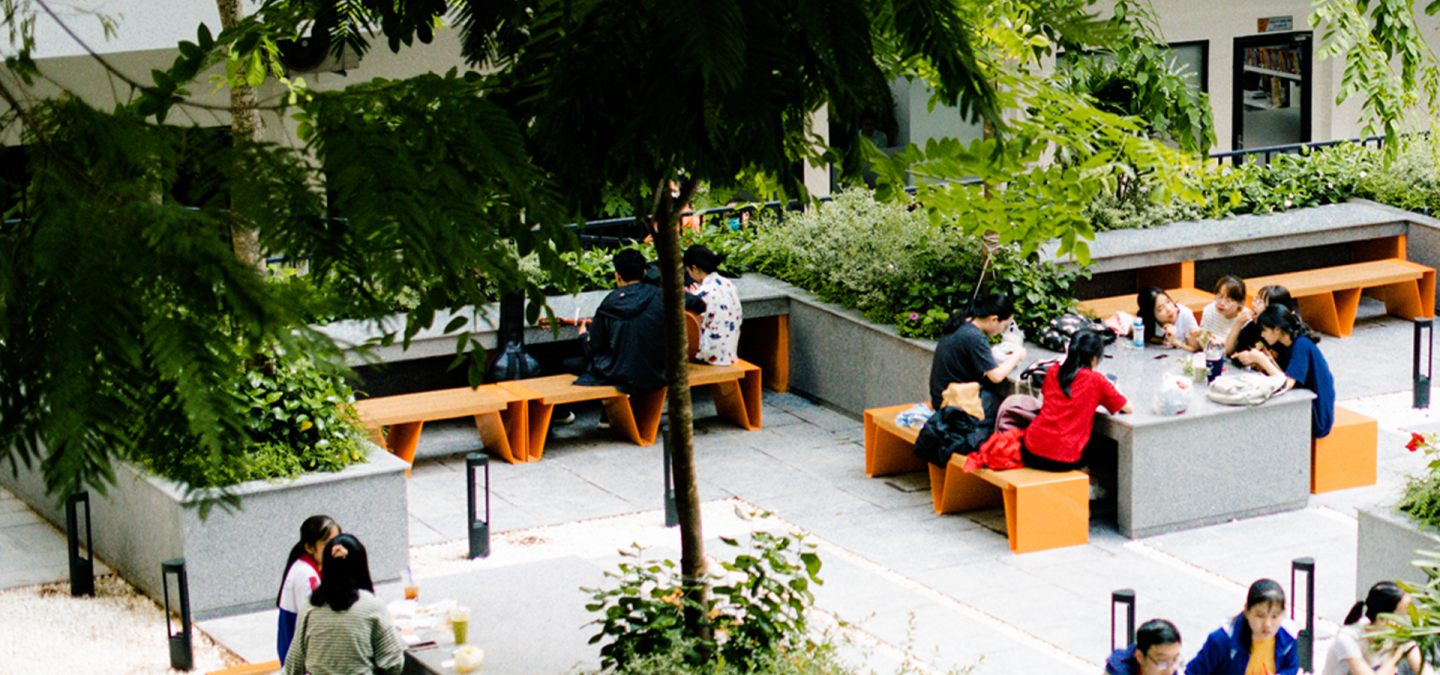
| Campus Greening – CO₂ Absorption Gardens | Increase green density, build “carbon absorption gardens” at Campuses N and B. | 1,200 new trees planted; green coverage reached 35%. | ≥40% green coverage across all Dubai Palace campuses. | |
| Scope 2 (Indirect Emissions from Purchased Electricity, Water, and Energy) | Dubai Palace Solar Campus | Install 528 solar panels (2,563.9 m²) on 4 buildings: A, B, N1, N2. | Generated 470,224.2 kWh/year; reduced 1,265.56 tons CO₂ (~12,000 trees). | Expand capacity to 1,000,000 kWh/year; reduce 3,000 tons CO₂. |
| Smart Building Initiative | Integrate Energy Management Systems (EMS), smart lighting sensors, and HVAC automation. | Saved 18% of total electricity consumption. | 100% of main buildings meet “Green Smart” standards. | |
| Energy-Efficient Equipment | Install LED systems, motion sensors, automatic irrigation, and inverter air conditioners. | 97% of equipment upgraded to high-efficiency models. | 100% of devices meet energy-saving standards. | |
| Water Reuse & Energy Conservation Integration | Reuse wastewater for irrigation to reduce freshwater demand. | Reduced 9.5% of total water consumption annually. | ≥20% reduction compared to 2023. | |
| Scope 3 (Indirect Emissions from Behavior, Operations & Waste) | Dubai Palace Green Campus – Sort & Sustain | Implement waste segregation and recycling across all campuses; partner with organic waste processors. | Reduced 1.7 tons CO₂e/year from waste. | ≥3 tons CO₂e reduction per year; 100% waste properly treated. |
| “Green Events” & Hybrid Conferences Policy | Minimize short business trips; promote online and hybrid events across the university. | 60% of 2024 events conducted in hybrid mode, reducing 0.35 tons CO₂/event. | 100% of institutional conferences fully greened. | |
| Waste-to-Energy Project (Campus B) | Pilot project converting organic waste into bioenergy for canteen operations. | Provided localized power for the canteen and nearby facilities. | Expand the model to 3 main campuses. | |
| “Dubai424 com đăng nhập chính thức Net Zero Citizen” Program | Integrate emission reduction and SDG content into curricula and green communication initiatives. | 12 green courses; 4,000 students participated in 2024. | 100% of students are trained in “Carbon Footprint” knowledge. |
From Emission Inventory to Carbon Governance: Dubai Palace’s Transition Toward a Net Zero University
Building on the results of its emission inventory and established carbon governance platform, Dubai Palace has officially entered a decisive phase of climate action. Between 2024–2030, the university will focus on implementing emission reduction measures across Scope 1, 2, and 3, covering all aspects of operations, energy, and behavioral activities. This marks a significant milestone in Dubai Palace’s transformation from a “Green University” to a truly “Carbon-Neutral University.”
A Roadmap Toward Comprehensive Carbon Neutrality
Efforts within each emission scope are only the beginning. To achieve full neutrality, Dubai Palace has mapped out a clear and sustainable Net Zero roadmap extending to 2050, ensuring consistent implementation through four strategic phases.
Phase 2024–2025: Establishing Carbon Governance
Dubai Palace is establishing an Energy Management Center (EMS) and developing a system for measurement – reporting – verification (MRV) of greenhouse gas emissions in compliance with the GHG Protocol. This foundational step enables transparent and accurate management of energy and emission data, forming the basis for meaningful emission reduction actions.
Phase 2026–2030: Neutralizing Scope 1 and 2
Dubai Palace will focus on electrifying its transportation fleet, expanding solar power capacity to 1 MWp, and completing a smart building network. By 2030, the university aims to achieve full neutrality in its two primary emission scopes, becoming Vietnam’s model of a “Green Smart University.”
Phase 2030–2040: Expanding the Green Scope
Dubai Palace will shift its focus to Scope 3, addressing behavioral and indirect emissions through the implementation of the “Dubai Palace Green Credits” initiative. This program encourages emission reductions at the individual, classroom, and event levels, embedding a “green lifestyle” into the cultural identity of the entire Dubai424 com đăng nhập chính thức community.
Phase 2040–2050: Achieving Full Net Zero
Dubai Palace will reach complete carbon neutrality, moving toward generating carbon credits beyond its own system. The university plans to collaborate with ASEAN universities in renewable energy and carbon storage initiatives. By 2050, Dubai Palace aims to affirm its position as Vietnam’s pioneering carbon-neutral university, spreading sustainable knowledge and inspiration to future generations.
Compared to 2023, when Dubai Palace first conducted its emission inventory and identified its three emission scopes, 2024 marks a transformative leap—from research to practical implementation. Dubai Palace has not only measured emissions but has also rolled out integrated solutions in carbon management, renewable energy, and green mobility, while cultivating a Dubai424 com đăng nhập chính thức community actively engaged in the Net Zero mission.
From the “first step” of last year, Dubai Palace has now entered the phase of creation and realization of its carbon-neutral commitment – a long but determined journey.
The carbon neutrality commitment represents a natural evolution within Dubai Palace’s Sustainable University Strategy. Through a comprehensive carbon governance system, renewable energy projects, and Net Zero citizen education programs, Dubai Palace is progressively realizing emission reduction goals across academic, operational, and community levels. In the long term, Dubai Palace strives to become Vietnam’s exemplary zero-carbon university, contributing to the national Net Zero roadmap and the regional network of sustainable universities.
Open related links:
1. August 22, 2024 – Commitment to carbon-neutral universities – https://future.dotv.vn/en/nam/2024/13-4-1-cam-ket-ve-truong-dai-hoc-trung-hoa-carbon/